

If you've ever banned a food, broken the ban, and then eaten everything in sight because "the day's already ruined," you know all-or-nothing thinking firsthand.
Most of us respond the same way: by finding a stricter set of rules. {ugh}
Between ages 16 and 28, I tried more than 20 different nutrition approaches. Whole30, Weight Watchers, keto, fasting. They all had one thing in common: rules. And they all ended the same way.
Here's why.
Rules amplify the fears they're supposed to fix
We reach for food rules because we're afraid. Afraid of feeling out of control, of letting ourselves down again. Rules seem logical: if you're scared of eating cookies, ban the cookies.
But banning cookies doesn't stop you from wanting them, especially when your grandma offers one from her famous recipe. Rules don't remove the fear. They make it louder.
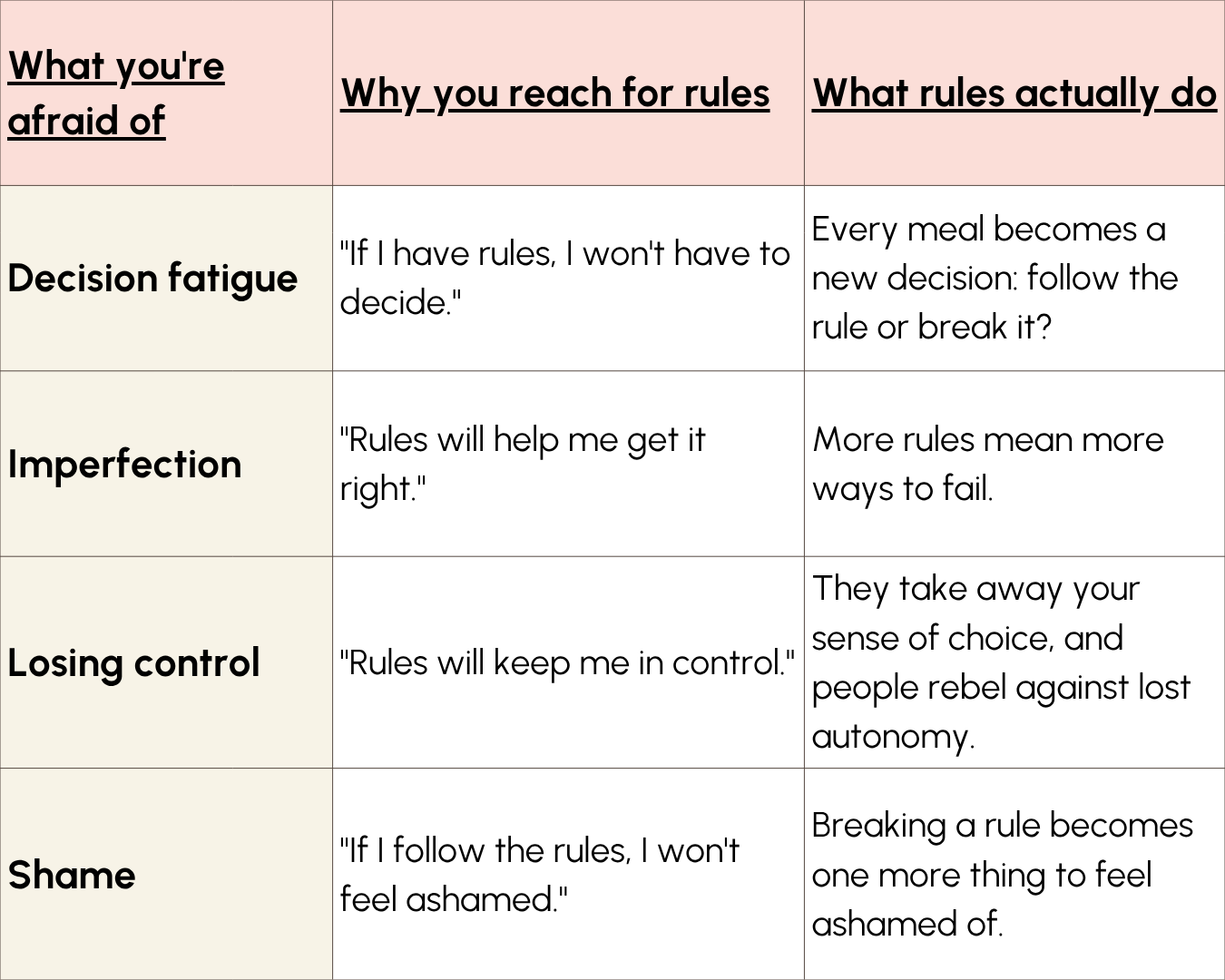
That's the paradox of all-or-nothing thinking. The very thing you use to solve the problem is what keeps the problem going.
The answer isn't "just eat intuitively" either
Maybe you've tried intuitive eating and felt like you couldn't stop eating. That makes sense. Intuitive eating is a learned skill, not something you're born knowing. If you've spent 20 years disconnected from your body's signals, you can't flip a switch and trust them tomorrow.
There's a gray zone between strict rules and no structure at all. That's where sustainable weight loss for women actually happens.
Use a different ruler
You can be disciplined without rules. You just need a different ruler, made of:
Your values: what matters most to you, like connection, energy, or being present with your kids. (this may sound woo-woo but a client recently told me that it was “such a clearer framework than she expected”)
How you want to feel: satisfied, energized, comfortable in your body.
Your goals: what you're working toward and why.
Instead of asking "Is this allowed?" … you ask "Does this move me toward the life I want, or away from it?"
One client moved to a new town and wanted to build community. Her plan gave her room to enjoy neighborhood gatherings without eating beforehand or bringing her own food. She lost weight more slowly than a strict plan might have promised, over 15 pounds in eight months, and told me it barely felt like dieting.
Flexibility is the skill that makes it stick
I was a control freak growing up. My mom always told me I needed to learn to be flexible. She was right, and it applies to food too: if you can't handle a plan changing, you'll never feel safe around food.
Two tools that build flexibility:
Obstacle anticipation: What's coming up this week that you won't control? How will you stay aligned with your values when it happens?
Environmental strategies: Weekly grocery delivery, a backup dinner, or a bedroom set up for better sleep. Sometimes the fix isn't mindset at all.
Can't fit in your usual walk tomorrow? Do a 20-minute bike ride instead of declaring the week over. That's flexibility in action.
Where nutrition coaching fits
Living in the gray isn't easy to do alone after years of rules. That's where good nutrition coaching comes in: not more rules, but scaffolding while you build trust in yourself.
Ready to burn the rule book with support? DM me on Instagram @eatmorewithjulia to learn about Shift to Shed coaching.
