November and December bring less routine, more treats, a fuller calendar and a much longer to-do list. So it's no wonder so many women decide to write off the season and "start fresh in January."
But here's the irony: the holidays are when you most want to feel good in your skin. You want to like what you see when you get dressed for the party, and you want to be present for the memories instead of stuck in your head about food.
You don't need a perfect plan to get there. You need a different definition of consistency.
Why the holidays feel impossible
Most of us secretly believe consistency means being perfect. Locked in. Every workout, every meal, every night of sleep exactly as planned.
By that definition, of course the holidays feel hopeless. Nobody can be perfect in December.
But when you sit the season out, you reinforce the belief that you can only be consistent when life is calm. Then January arrives, you start over, and the cycle repeats.
Step 1: Write your "winning list"
Before you change a single habit, answer one question: How would I win if I were more consistent?
Be specific. Would you:
Feel more confident getting dressed for holiday parties?
Have more energy for your kids instead of feeling sluggish?
Feel clearer and calmer after a walk?
Actually want to be in the family photos this year?
Keep this list somewhere you'll see it. When consistency feels like a chore, you'll drop it the minute life gets busy. When it feels like something that helps you win, you'll protect it.
Step 2: Brainstorm a "minimum version" for each habit
Instead of an all-or-nothing plan, decide ahead of time what the smallest version of each habit looks like on a chaotic day:
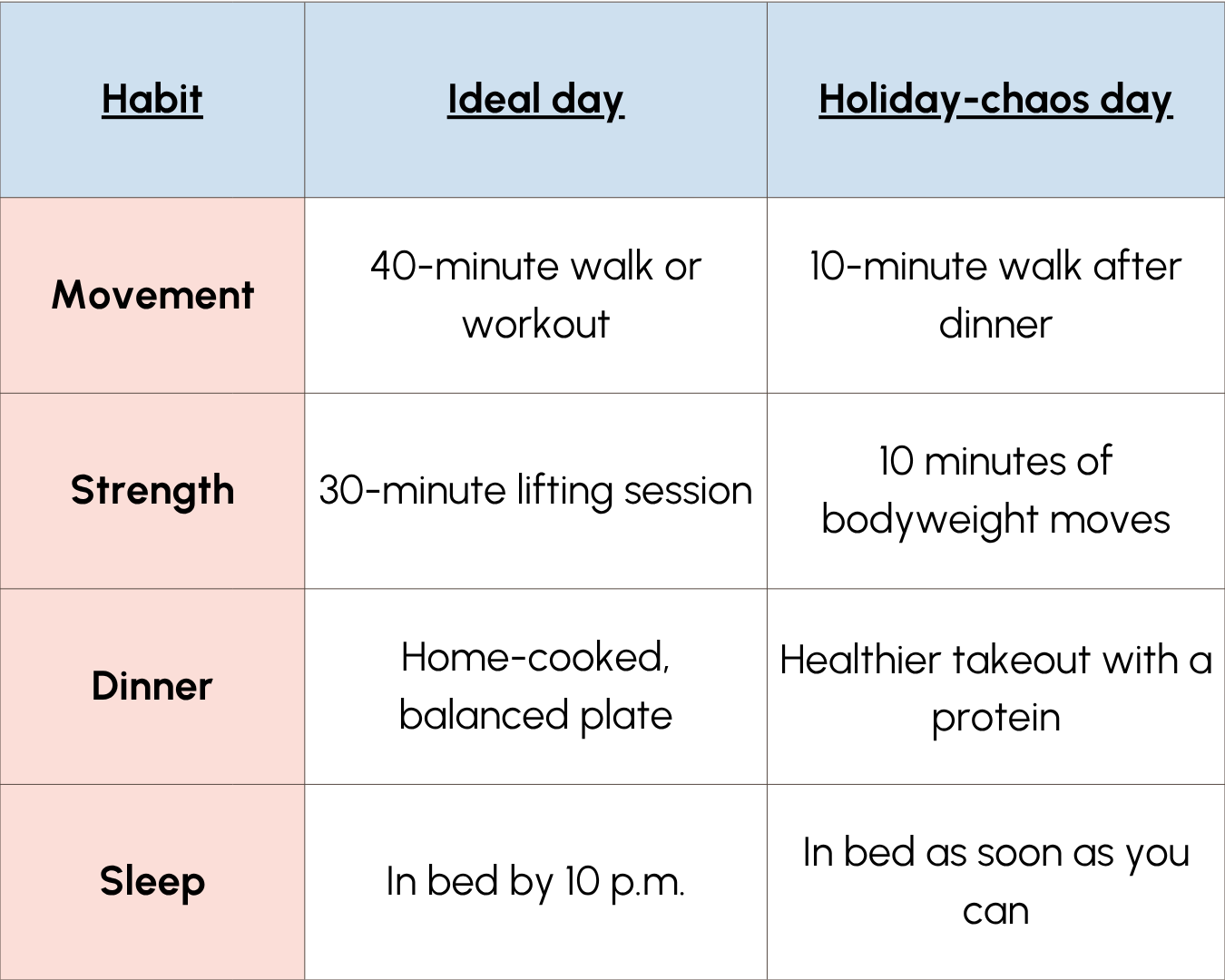
The minimum version isn't failing. It's what keeps you in motion, and staying in motion is what consistency actually is.
Step 3: Treat hard days as proof, not failure
Bad days are guaranteed this time of year. What matters is what you do next.
The next time you feel the urge to throw in the towel, try this thought instead: This is my chance to prove I'm consistent.
Then do the minimum version. Every time you do, you collect evidence that you're someone who keeps going, and that evidence is what makes next time easier.
Step 4: Drop the punishment
If you tend to be hard on yourself, this one matters most. Harsh self-talk after a slip doesn't make you more disciplined. It makes you want to escape yourself, and for many of us, that escape looks like overeating, scrolling or zoning out in front of the TV.
As Katherine Morgan Schafler writes in The Perfectionist's Guide to Losing Control, making positive changes doesn't require punishment. [book link, affiliate]
Swap the verdict for curiosity:
Instead of "I'm so undisciplined," ask "What made today hard?"
Instead of "I ruined it," ask "What's my next good choice?"
Instead of "I'll start over in January," ask "What's the minimum I can do tomorrow?"
Step 5: Stay connected
Change is hard, but hard isn't the same as miserable. Doing something difficult with support feels energizing. Doing it alone, while criticizing yourself, feels exhausting.
That support can come from a friend, a partner, a coach or a community. And it starts with being on your own side.
The bottom line
You don't have to be perfect this holiday season to be consistent. You just need to know why it matters to you, have a minimum version ready, and keep going after the hard days without punishing yourself.
Listen to the full episode: "Why do I fall apart every November and December?" Listen here
Want help putting this into practice? Join the Get Consistent Challenge on December 8, 9 and 10. We'll uncover the specific thoughts holding you back from being consistent for good. Save your spot