

You don't have a knowledge problem
If you could recite the macros in a chicken breast but still can't make it past Thursday “being good”, information isn't what you're missing.
The gap is somewhere else: your behavior can't work without matching beliefs.
If part of you believes "I can't be trusted around sweets" or "I always fall off on weekends," your brain will work hard to prove itself right, no matter how good your plan is.
Most women raised in diet culture carry two voices that fight over every food decision:
The Rule Follower wants to cut out sugar, give up carbs, and be perfect so she never has to think about it again.
The Rebel wants to say "screw it" and eat whatever's in front of her, because the rules feel suffocating.
You bounce between them, feeling deprived when one is in charge and bloated and guilty when the other takes over. Consistency lives in the middle, and you get there by changing how you think, not by finding a stricter plan.
Here are the three shifts I use with every client to get there: curiosity, aim, and evidence.
Quick self-check: which one are you missing?
Read the middle column and notice which row sounds most like you. That's where to start.
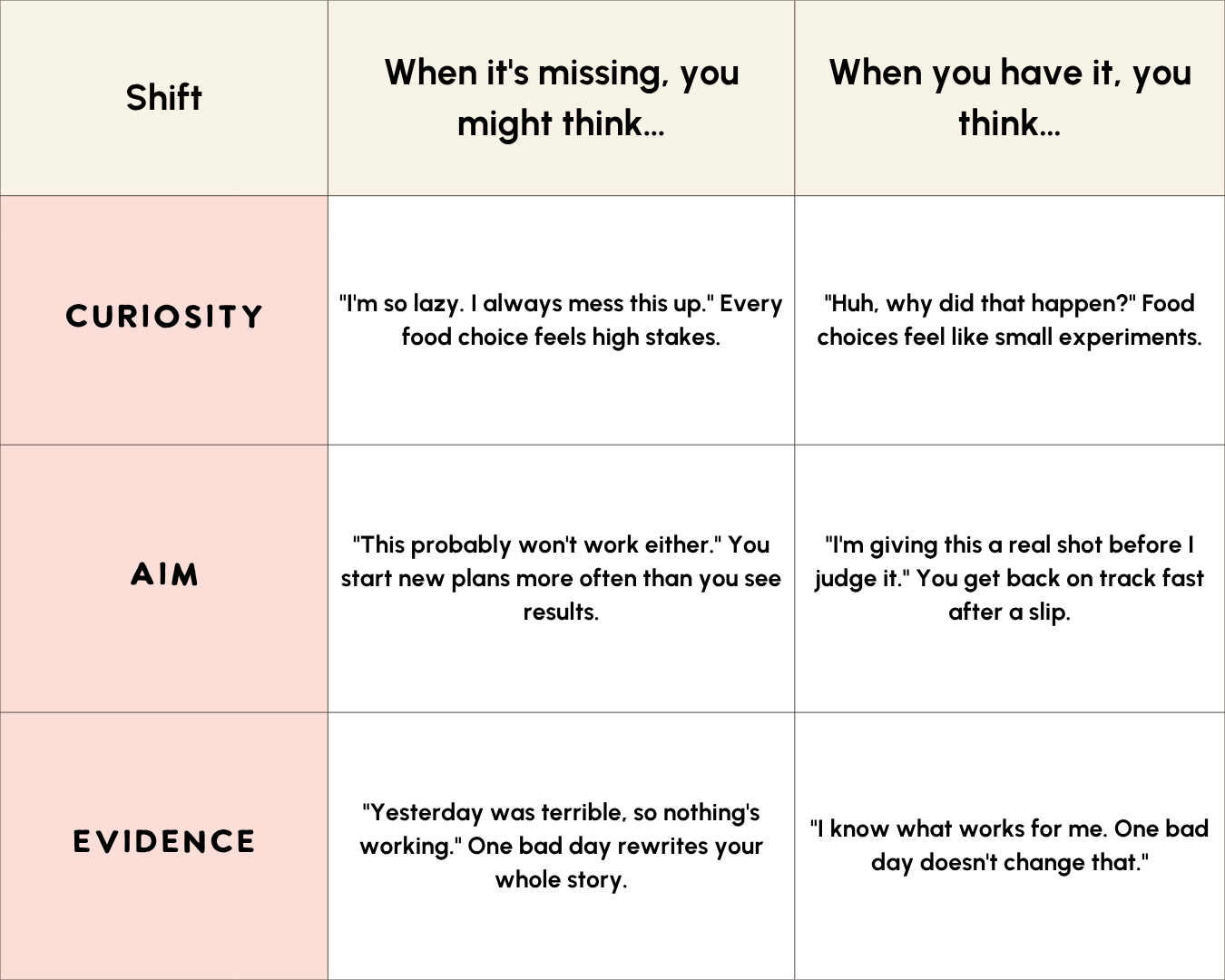
Most women see themselves in all three. That's normal. Pick the one that stings the most and start there.
Shift 1: Curiosity — trade the verdict for a question
The word curiosity comes from the Latin for "care." Being curious means being careful about which thoughts you let run your day.
When something goes off plan, most of us hand down a verdict immediately: lazy, weak, no willpower. A verdict ends the conversation. A question keeps it going, and the answer is often something that has nothing to do with food at all, like stress, avoidance, or simply being underfed earlier in the day.
Try these swaps the next time a judgment pops up:
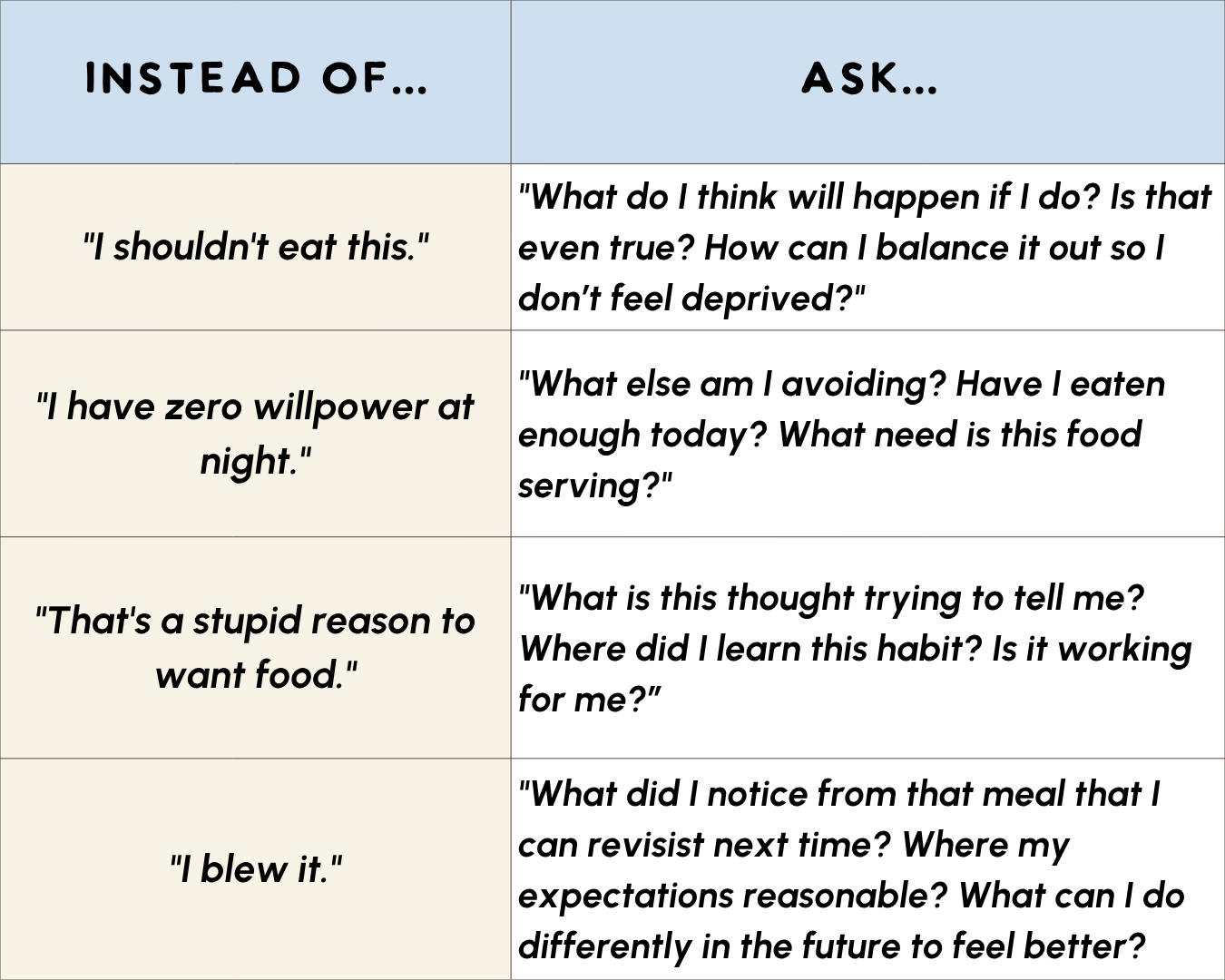
The "silly" thoughts are often the most useful ones. Let them finish their sentence before you dismiss them.
Shift 2: Aim — see it through before you switch
Aim isn't perfection. It's picking one direction and staying pointed at it long enough to find out if it works.
If you've ever started a new plan while quietly planning what you'll try after this one fails, you're missing aim. Your goal hasn't changed in years, but your strategy changes every few weeks, so nothing ever gets a fair test. You can argue both sides of everything (more protein, less protein, track, don't track) and win each argument depending on your mood.
The fix is to aim at who you're becoming, not at a rigid set of behaviors. Ask:
Who is the version of me who has this handled? What does she prioritize?
Why is her life better than mine is right now?
What short-term trade-offs is she willing to make for that?
Then run every decision through one filter, like "Will this actually make me feel good afterward?" Choices that once felt out of character, like stopping at one glass of wine, start to feel easy because you can picture the version of you who wakes up feeling great the next morning.
Shift 3: Evidence — let the last 24 days outvote the last 24 hours
The only evidence that matters for your decisions is your own: not a study, not a trend, not what worked for you ten years ago.
Without a record, the last 24 hours shout louder than everything else. One rough day convinces you nothing is working, and you're back to square one. With a record, you can look back and say, "I know what works for me, and today doesn't change that."
This doesn't have to be fancy. A note on your phone works. Subjective data counts as much as the scale. Try writing down:
How you felt after a meal: "High-protein breakfast, not hungry until 1."
Sleep and energy: "7.5 hours, way fewer cravings today."
Alcohol and the next day: "Two glasses, slept badly, snacky all afternoon."
Your cycle: "Hungrier the four days before my period, every month."
How you got back on track: "Had extra dessert, went back to normal at breakfast, felt fine."
That last one is the most powerful. Every time you prove you can bounce back quickly, the next bounce gets easier.
Try it: a 7-day consistency experiment
You don't need to wait for Monday. Start whichever day you're reading this.
Day 1 — Choose your aim. Write one sentence about who you're becoming and one filter question you'll use all week (your personal values are a great place to start!!)
Day 2 — Catch one “verdict.” The first time you judge yourself around food, rewrite it as a question and answer it honestly.
Day 3 — Start your evidence note. Write down one thing that made you feel good today and one that didn't.
Day 4 — Run a tiny experiment. Eat half of something you usually finish, then pause and decide on the rest.
Day 5 — Plan for one hard moment. Pick something coming up this weekend and decide now how you'll handle it.
Day 6 — Practice the bounce-back. If something goes off plan, make your very next choice an intentional one and write down how it felt.
Day 7 — Read your evidence. Look back at the week. What pattern do you see? What will you keep doing next week?
Want to go deeper?
I walk through all three shifts, including the client breakthrough that showed one woman her "sugar problem" was never about sugar, in the podcast episode "How can I be so smart... but so bad at weight loss?" Listen here.
If you'd rather not do this alone, this is exactly what we work on in Shift to Shed private coaching. Starting before the holidays means you walk into 2027 already knowing what works for you, instead of starting over on January 1st. '
DM me CONSISTENT on Instagram @eatmorewithjulia and we'll talk about whether it's a fit.
